

If you live in New Hampshire long enough, you learn that fall isn’t really a season — it’s a countdown. The window between the last warm weekend of October and the first serious snow of November can be as short as three weeks. Everything you need to do outside, you need to do in that window. And your roof, more than almost anything else on your property, has a specific list of things it needs from you before winter arrives.
Winter is the season your roof will be tested hardest. It’s also the season when it’s most expensive and least convenient to fix any problem you find. A roof that goes into winter healthy has a dramatically better chance of coming out of winter healthy. A roof with any of the five issues in this checklist unaddressed can turn a normal season into an insurance claim.
This is the maintenance list we walk NH homeowners through every fall. None of it is complicated. Most of it you can do yourself in a Saturday morning. The one item you shouldn’t do yourself, we’ll do for you at no cost. Here’s the plan.
Why Fall Is the Only Time to Do This
A quick word on timing, because it matters more than most homeowners realize. There are really only two windows a year when your roof is easy to work on: late spring, and mid-fall. In summer, roof surface temperatures hit 150°F+ and shingles get too soft to walk on without leaving marks. In winter, ice and snow make anything on the roof both dangerous and impossible to inspect properly.
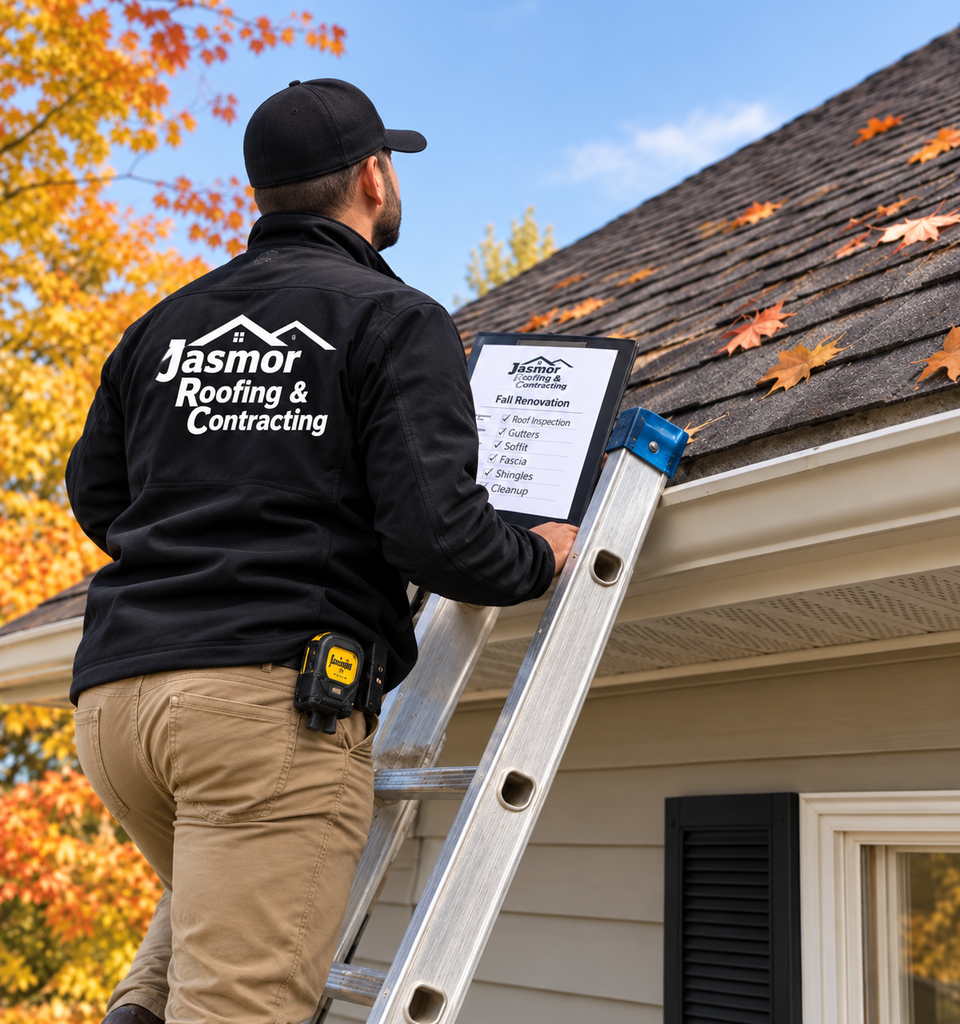
That leaves fall. Specifically, the six-to-eight-week window from mid-September to mid-November when temperatures are mild, foliage is off (or nearly off), and the roof is dry and cool enough to inspect carefully. Miss that window and your options for the next four months narrow considerably.
If it’s already October when you’re reading this, don’t panic — you still have time to work through the list. But don’t push it into a “maybe next weekend” indefinitely, either. The first serious snow of the year has a way of arriving several weeks earlier than any of us expect.

The 5 Items on the Checklist
| 1 | Clean Your Gutters — Twice, If You Have Trees |
|---|---|
| Do it once when leaves are mostly down, then again a week or two later |
Why it matters
Clogged gutters are the number-one preventable cause of ice damming, fascia rot, and foundation water issues on NH homes. When a gutter is full of leaves, meltwater has nowhere to go. It backs up onto the roof edge, saturates the fascia, freezes overnight, and starts the ice dam cycle that leads to leaks and interior damage weeks later.
How to do it
If your gutters are ground-level accessible, a ladder, work gloves, and a small hand rake or scoop are all you need. Scoop out the leaves and debris, then run a garden hose through the gutter to confirm water flows freely to the downspout and out to daylight (or into your drainage system). If water pools in the gutter or trickles rather than flows, you likely have a clog somewhere in the downspout — snake it with the hose or a plumber’s auger.

The twice-a-fall detail
Most NH homeowners clean their gutters once, usually in mid-October when the leaves are visibly down. The problem is that trees continue to drop leaves for another two to three weeks after peak color — and the last batch of leaves (often small oak leaves) is the batch that clogs your gutters right before winter arrives. Clean once when the yard is covered, then again ten to fourteen days later. It’s a small extra effort with a large payoff.
When to call a pro
Two-story homes, steep pitches, or any situation where you’d be uncomfortable on the ladder — hire it out. A professional gutter cleaning runs $150–$350 for most NH homes and is dramatically cheaper than the emergency call in February.
| 2 | Trim Back Overhanging Branches |
|---|---|
| Anything within 6 feet of the roof needs to come off |
Why it matters
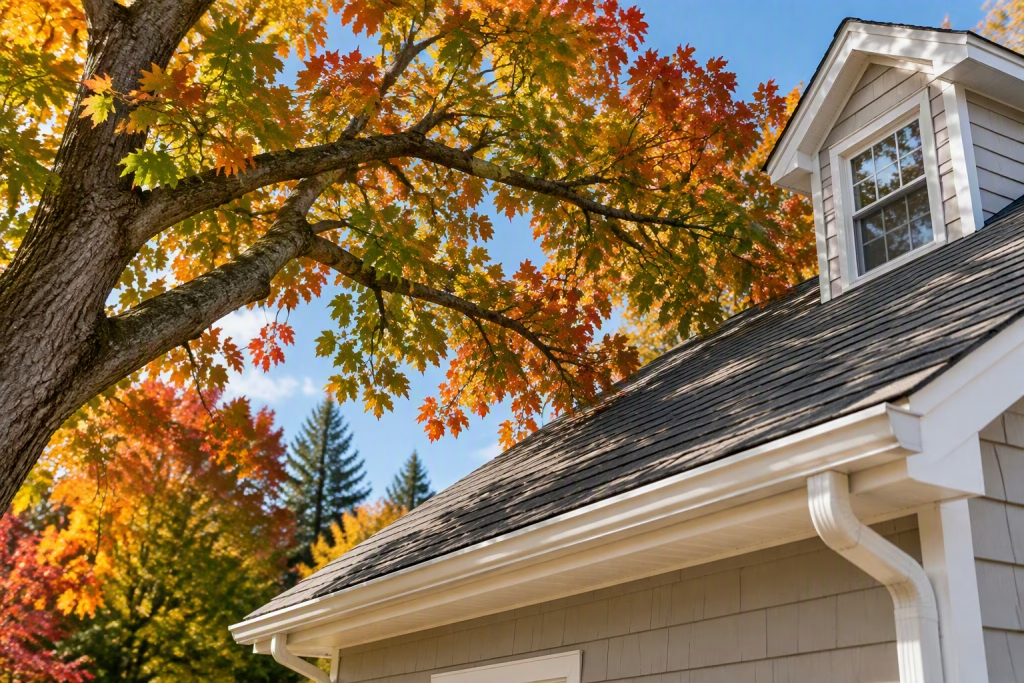
NH gets heavy, wet snow — the kind that loads onto branches and can bring them down hard. Every winter we get calls from homeowners whose roof took a hit from a branch that shouldn’t have been there in the first place. Even smaller branches that don’t fall can scrape shingles, wear granules off in the friction zone, and channel water onto areas of the roof that weren’t designed to shed it.
How to do it
Walk your property with a critical eye. Any branch that hangs over the roof, or comes within about 6 feet of the roof surface, is a candidate for removal. Small limbs you can handle yourself with a pole saw or hand pruners. Anything larger than about 3 inches in diameter, anything over your head, or anything near power lines — hire an arborist. This is one of the categories where amateur pruning does more damage than professional pruning costs.
The tree-canopy long game
Even trimmed properly, trees continue to shed sap, seed pods, needles, and leaves onto the roof year-round. If you have significant tree canopy over your roof, plan for more frequent gutter cleanings and expect the covered sections to age faster than exposed sections. This is normal, but worth flagging for your estimator when the roof eventually needs replacement — different underlayment or additional maintenance planning may be warranted.
| 3 | Do a Slow Ground-Level Roof Walk-Around |
|---|---|
| You can spot 90% of trouble without ever getting on the roof |
Why it matters
Most roof problems announce themselves visually before they become leaks. If you catch the visual warning signs in October, you have time to schedule a real repair. If you miss them and discover the problem in January when water is coming through your ceiling, you’re paying emergency rates for a stop-gap fix and full repair rates for the real solution in spring.
What to look for
Start with your phone — take photos of your roof from all four sides of the house, then look at them on a screen where you can zoom. Compare slopes. Look for:
- Missing, curled, cupped, or lifted shingles (see our Blog on UV Damage for what these look like)
- Bald patches where granules have washed away, exposing darker asphalt underneath
- Dark streaks running down from the ridge, especially on north-facing slopes (algae or moss)
- Rusted or lifted flashing around chimneys, skylights, and vent pipes
- Sagging or unevenness in the roof line — indicates deck or structural issues
- Piles of granules at the base of downspouts (a reliable sign of shingle aging)
- Any visible daylight through vents that should be sealed
What to do with what you find
If everything looks clean, great — proceed to step 4. If you spotted anything on the list above, don’t wait. Schedule a professional inspection while there’s still time to address issues before winter. A visible warning sign in October is a scheduled repair; the same sign discovered in January is an emergency.
| 4 | Check the Attic — Ventilation and Insulation |
|---|---|
| This is where NH winters do the most invisible damage |
Why it matters
As we covered in depth in our Blog – Why Your Attic Is Suffocating, the condition of your attic in winter determines whether you get ice dams, condensation damage, and premature roof aging. Fall is the last chance to catch and fix any issues before the ventilation system is under its heaviest load.
What to check
Grab a flashlight and head up. You’re looking for:
- Soffit vents that are clear — no insulation pushed up against them from the inside, no paint or debris blocking them from the outside
- Ridge vent (if you have one) intact and unblocked at the peak
- Insulation depth roughly consistent across the attic floor — no obvious bare patches or heavily compressed areas
- No visible moisture, staining, or mildew on the underside of the roof deck
- No daylight visible around plumbing vents, chimneys, or attic hatch (these are air leaks that push household moisture into the attic)
- Rodent activity — droppings, nesting material, or gnaw marks around vents (rodents get in through gaps that also let out heat)
Common problems and quick fixes
Insulation blocking soffit vents is the most common issue we see, and it’s fixable in an afternoon — carefully pull insulation back from the eaves and consider adding rafter baffles to hold it in place. Small gaps around ceiling penetrations can be sealed with expanding foam. Larger ventilation deficiencies — missing exhaust venting, undersized intake, chronic condensation — typically require professional evaluation and shouldn’t wait until spring.
| 5 | Schedule a Free Pre-Winter Professional Inspection |
|---|---|
| The one item on this list you shouldn’t do yourself |
Why it matters
A homeowner walk-around catches 90% of visible issues. A professional inspection catches the other 10% — the flashing details, subtle wear patterns, seam issues, and structural concerns that require training and roof access to spot. That last 10% is disproportionately the stuff that causes winter emergencies.
What a pre-winter inspection includes
At Jasmor, a free fall inspection covers:
- Full walk of accessible roof surfaces (weather permitting)
- Detailed check of all flashing around chimneys, skylights, and wall junctions
- Condition assessment of all shingles — granule loss, aging, wind lift
- Full attic ventilation evaluation — intake, exhaust, balance, insulation condition
- Gutter and drainage system check
- Ice-dam risk assessment based on attic conditions and roof geometry
- Written report of findings with photos and clear recommendations, sorted by urgency
Why do it now, not later
Two reasons. First: October and early November are when roofing calendars are still open — by mid-November, everyone is triaging existing customer emergencies, and appointments get hard to schedule. Second: any issue an inspection surfaces almost always needs to be addressed while the weather still permits roof work. A repair that’s easy in October becomes impossible in December.
Free means free
A Jasmor pre-winter inspection is genuinely no-cost and comes with no obligation to hire us for any resulting work. If the inspection turns up nothing, we’ll tell you the roof is in good shape and go home. If it turns up something, we’ll walk you through what we saw and what your options are — no pressure, no scare tactics. About a third of the inspections we do result in “you’re fine, no action needed.” We think that’s important, because it means when we do recommend work, homeowners can trust the recommendation.
What Happens If You Skip the Checklist
Homeowners who skip fall roof prep are the majority of our winter emergency calls. Here’s the pattern we see, in roughly the order it plays out:
- First serious snow of the season melts partially, refreezes at the eaves (because gutters were clogged and eaves iced up), and the first ice dam of the season forms
- Second snowstorm loads the ice dam further; water starts backing up under the shingles
- Third or fourth event pushes water into the wall cavity or ceiling; homeowner notices staining
- By this point (usually late January or early February), a contractor call gets triaged behind others already in progress; temporary tarping is what’s available immediately, permanent repair waits for spring
- Insurance claim gets filed for interior damage; deductible eats the first several thousand of the loss; premiums often go up the following year
Total cost of skipping the fall checklist: often $3,000–$10,000+ in interior damage, contractor emergency rates, and insurance impact. Cost of the checklist itself: a Saturday morning and a free inspection appointment. It’s one of the most asymmetric returns on preventive time we’ve ever seen.
The Bottom Line
A roof that goes into a NH winter prepared has a very different experience from one that doesn’t. The difference isn’t complicated — it’s the five things above, done in the six-week window between mid-September and early November. Four of those things you can do yourself in a morning. The fifth we’ll do for you, at no cost, whenever it fits your schedule.
If you’d like to get on the pre-winter inspection schedule, or if you found something on your walk-around that you’d like us to take a look at, we’re booking now and would rather see you in October than in January.
| Book Your Free Pre-Winter Roof Inspection |
| Every fall inspection includes a full ventilation, flashing, and shingle wear assessment — written report with photos. Owens Corning Platinum Preferred Contractor serving Concord, Loudon, Laconia, and Central NH for 20+ years. |
| Call (603) 961-0335 or request your free estimate online here. |