
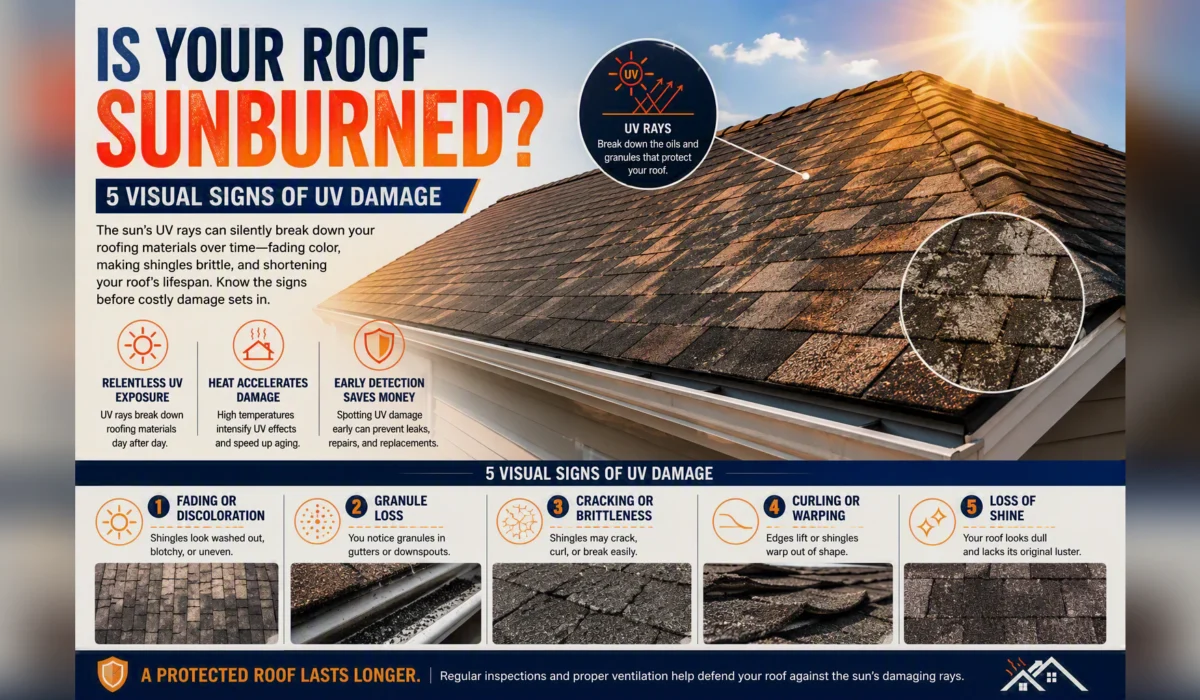
Yes, roofs get sunburned. Not in a metaphorical way — in a literal, measurable, chemistry-does-what-chemistry-does way. The same ultraviolet radiation that damages your skin on a July hike in the Whites is doing similar damage to your asphalt shingles every hour they’re exposed to daylight. Unlike your skin, though, your roof can’t heal, doesn’t get to hide indoors, and doesn’t have any protection except the granules embedded in its own surface.
New Hampshire homeowners sometimes assume our northern latitude gives us a break on UV. It doesn’t. NH gets plenty of intense summer sun — long days, high angles from May through August, and reflected UV off snow cover for another five months of the year. The southern and western slopes of your roof, in particular, catch a full daily dose that adds up to hundreds of thousands of hours over a roof’s lifespan.
Over time, that UV exposure does specific things to asphalt shingles that leave specific visual fingerprints. If you can spot those fingerprints early, you can plan for a roof replacement on your timeline instead of reacting to a leak on the roof’s timeline. This is the diagnostic guide we wish more homeowners had before they called us in a panic.
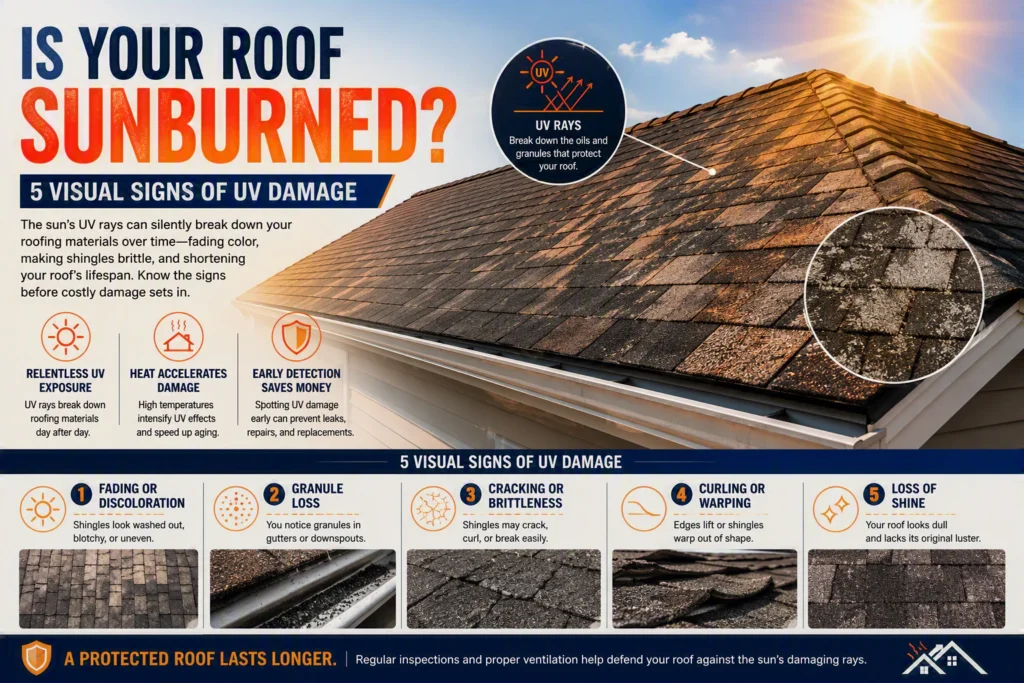
What UV Actually Does to an Asphalt Shingle
An asphalt shingle is a layered composite. From bottom to top, it’s roughly:
- A fiberglass mat (the structural backbone)
- An asphalt coating (the waterproofing layer, saturated with oils and additives)
- A surface layer of ceramic-coated mineral granules (the visible color, and the UV shield)
Everything about the shingle’s longevity depends on those granules staying attached to the asphalt underneath. Granules do three critical jobs: they give the shingle its color, they add weight and impact resistance, and — most importantly — they absorb and reflect UV before it can reach the asphalt beneath.
When UV finally reaches the asphalt (through worn or lost granules, or by direct exposure at the edges), it accelerates a chemical process called oxidation. The oils in the asphalt evaporate. The remaining asphalt becomes more brittle, less flexible, and less waterproof. And the bond between the asphalt and the granules weakens further — which exposes more asphalt, which speeds up the oxidation, which loses more granules. It’s a cascading failure that plays out over years.
The five visual signs below are the stages of that cascade, roughly in the order you’ll see them. Most roofs will show more than one sign at a time by the time damage is visible from the ground. All five together typically means the roof is near the end of its useful life.
The 5 Visual Signs of UV Damage
| 1 | Fading and Color Loss The color of your shingles is starting to wash out |
What it looks like
The most subtle sign, and often the first. Your shingles gradually lose their saturation — a Driftwood roof looks paler, an Estate Grey roof looks more washed out, an Onyx Black roof shifts toward dark charcoal. The change is easiest to spot by comparing your south-facing slope to your north-facing slope side by side. If they’re clearly different shades, you’re seeing UV bleaching in real time.
What’s actually happening
The ceramic coating on the granules is designed to be UV-stable, but it’s not UV-proof. Over years of exposure, the color pigments in the coating gradually fade. This alone isn’t a roof failure — a faded roof can still be perfectly functional — but it’s a reliable indicator that your shingles are aging, and it usually correlates with other signs listed below.
How urgent
Not urgent by itself. But if fading has been dramatic and your roof is more than 15 years old, it’s worth having someone take a closer look for the other signs that usually appear alongside it.
| 2 | Granule Loss You’re seeing bald spots — or granules in the gutters |
What it looks like
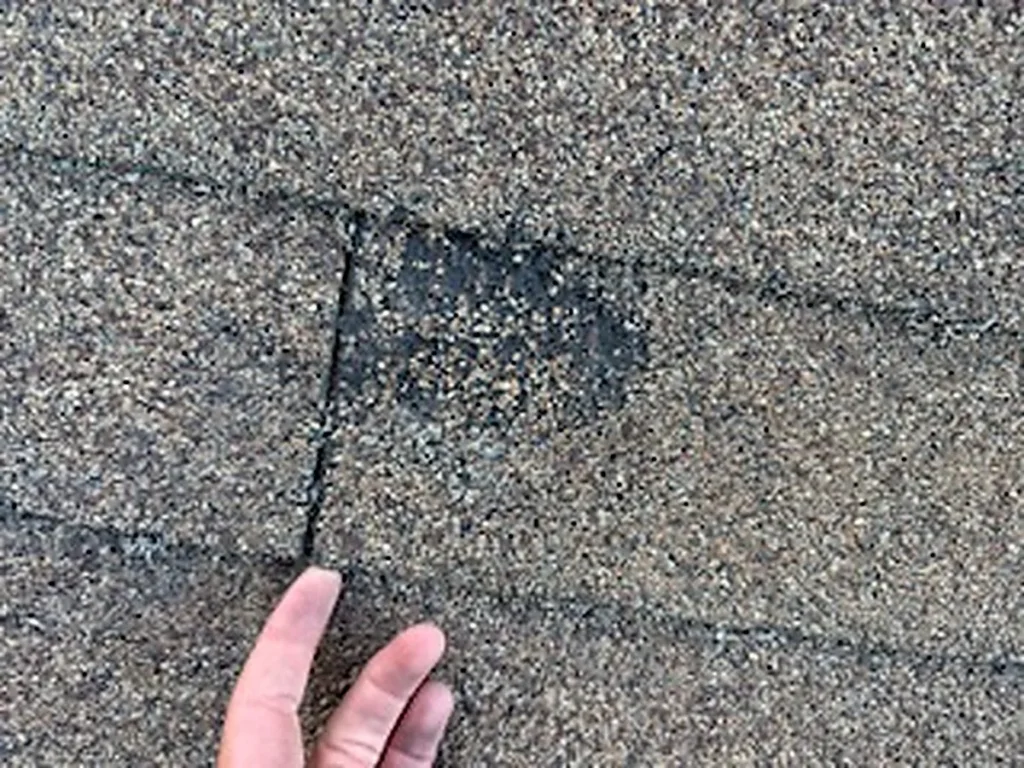
Discoloration on the roof surface where clusters of granules have detached, exposing the darker asphalt layer beneath. From the ground, these often look like patches or streaks of a lighter color, or areas where the roof texture looks noticeably smoother than the surrounding shingles. The most reliable place to check is your gutters and downspouts — after every rainstorm, look at what’s collecting there. Granules look like coarse black or gray sand.
What’s actually happening
This is where UV damage starts to matter. Once granules are gone, the underlying asphalt is exposed to direct UV, and the cascade accelerates. Some granule loss is normal in the first few weeks after installation (loose granules that were never fully embedded). But ongoing granule loss years into a roof’s life is a sign of active deterioration.
How urgent
Moderate to high. Some granule loss can be managed by monitoring. But if you’re consistently finding significant granules in the gutters and can see visible bald patches on the roof, you’re looking at a shingle whose UV defenses are compromised. It’s time for a professional inspection to assess how much life is left.
| 3 | Cupping and Curling Shingle edges are lifting or turning up at the corners |
What it looks like
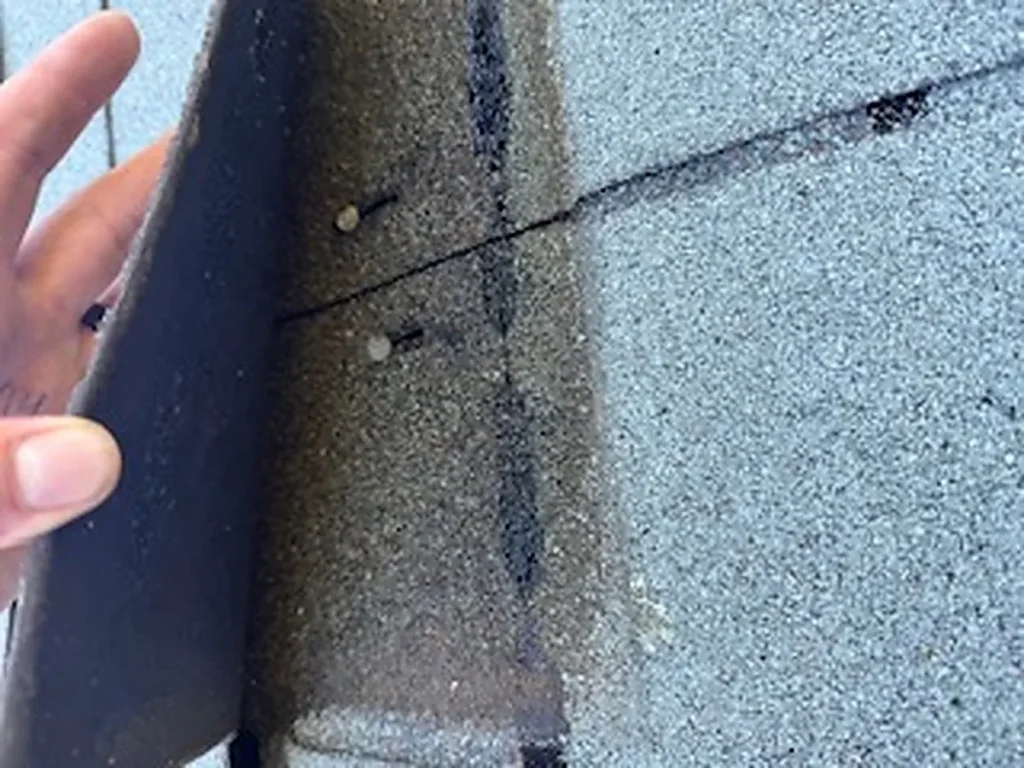
Shingles losing their flat profile. Cupping is when the center of the shingle rises, giving the shingle a shallow bowl shape. Curling is when the edges lift or turn up — most visible on the shingle corners. Both are easiest to see from the ground on the lowest visible course of shingles at the edge of the roof, or by scanning across a slope at a low angle in the late-afternoon light, which throws long shadows and makes any surface unevenness obvious.
What’s actually happening
As UV degrades the asphalt, the shingle loses its flexibility. The material shrinks unevenly — the top surface (which has taken the UV hit) contracts, while the underside (protected from UV) stays closer to its original dimensions. The result is a shingle that curls or cups because its two sides are no longer the same size. It’s the shingle-scale version of what happens to a piece of leather left in the sun.
How urgent
High. Curled or cupped shingles are dramatically more vulnerable to wind damage — the lifted edges catch wind that a flat shingle would shed, and can be torn loose in the next major storm. If you have visible curling across multiple sections of the roof, you’re on the clock. A NH nor’easter can turn a curling roof into a leaking roof overnight.
| 4 | Cracking and Checking Fine cracks are forming in a pattern like dried mud |
What it looks like
Small, hairline cracks appearing across the surface of individual shingles — often in a pattern that resembles cracked dried mud or the scales of an alligator (which is why roofers sometimes call this pattern “alligatoring”). Individual cracks are usually short and thin, but together they can cover most of a shingle’s surface. Best spotted up close, but visible from the ground with good light on aged roofs.
What’s actually happening
This is oxidation showing up as physical damage. Once the asphalt loses enough of its oils, it can no longer flex through thermal expansion and contraction. Every hot-cold cycle — and NH has 80–100 freeze-thaw cycles a winter alone — creates tiny stress fractures. Those fractures accumulate, network together, and eventually cover the shingle’s surface.
How urgent
High to critical. Cracked shingles no longer effectively shed water. Rain drives into the cracks, freezes overnight in the winter, and physically pries the shingle apart. Leaks are usually within a season or two of cracking becoming widespread. This is the last major visual sign before functional failure begins.
| 5 | Brittleness and Breakage Shingles are snapping and losing pieces |
What it looks like
Individual shingles have become brittle enough that they physically fracture. You might see missing corners, chunks broken out of the visible tab pattern, or (if you’re walking the roof) hear shingles crunching or cracking under your weight. Debris on the ground below the eaves — small dark fragments after a wind event or heavy rain — is a reliable ground-level sign.
What’s actually happening
This is UV-degraded asphalt at end-stage. What was originally a flexible, weather-shedding composite has become dry, hard, and glass-like. Any mechanical stress — wind, hail, tree branches, ice movement, or foot traffic — snaps the material. The shingle mat has lost the properties that made it a shingle. It’s still holding on to the roof for now, but it’s no longer providing meaningful protection.
How urgent
Immediate. A roof this far into UV degradation is functionally at the end of its life. Leaks are typically already occurring or imminent. Any storm can turn a manageable situation into an emergency. If you’re seeing this sign — visible shingle fragments in the yard, missing pieces on the roof, brittle debris — you should be planning a replacement, not a repair.
Which Slopes to Check First on a NH Home
UV damage isn’t uniform across your roof. On virtually every NH home, damage progresses fastest on the south- and west-facing slopes. Here’s why, and where to look:
- South-facing slopes take the highest daily UV load. The sun tracks across the southern sky year-round, and the south face of your roof gets 5–7 hours of direct exposure daily in summer, plus significant winter exposure when the angle is low but reflected UV is still substantial.
- West-facing slopes get the hottest, most intense afternoon sun. Roof surface temperatures peak on west faces because the sun is at its strongest just as the day’s ambient temperature also hits its highest.
- North-facing slopes almost never fail from UV first. They fail from other causes — moss, algae, ice dam formation — because they stay cool and damp. If your north face looks better than your south face, that’s not necessarily reassuring; it’s the expected pattern.
- East-facing slopes are moderate. They get strong morning sun but temperatures cool through the day, giving the shingles thermal relief.
When our estimators walk your roof, we always compare all four orientations. A significantly worse south or west slope is a strong indicator of UV-driven aging and often changes the calculation on whether to repair vs. replace.
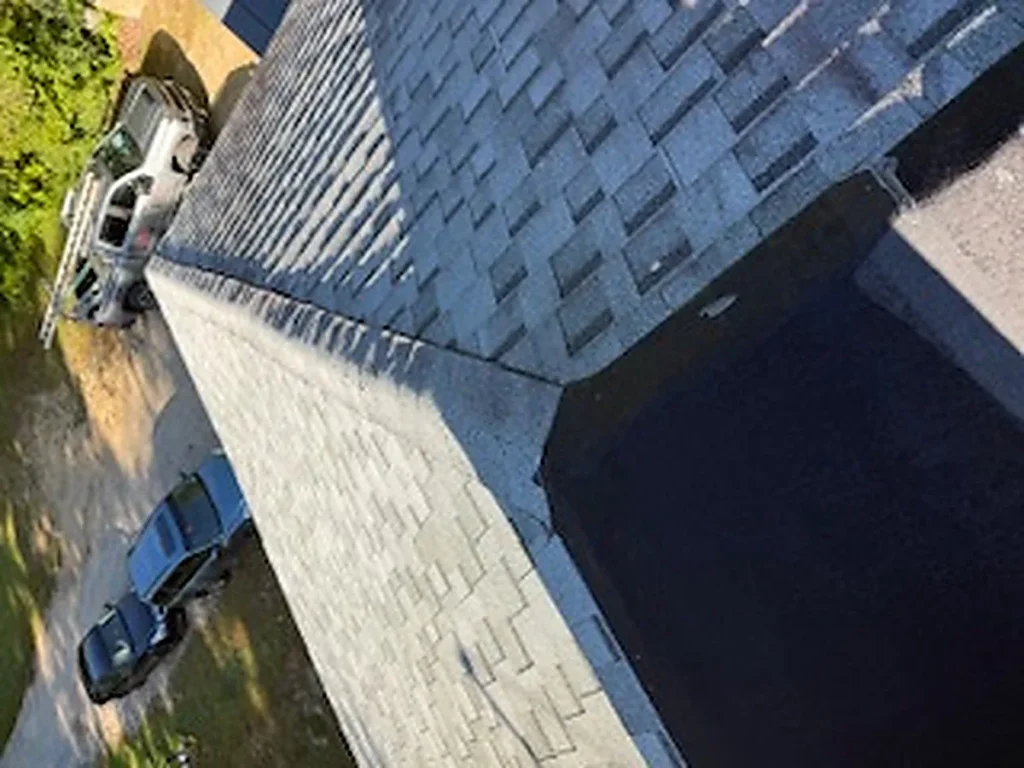
| A quick DIY inspection you can do this weekend Grab your phone and take four photos of your roof from ground level — one from each side of the house. Get as much of each slope in frame as possible. Then compare them side by side on your screen. Do the south and west faces look noticeably worse than the north and east? Different color? More streaking? More visible surface irregularity? If yes, UV aging is present and it’s worth having a professional inspection. If they all look about the same, you’re in good shape. |
What to Do If You Spot the Signs
The right response depends on how many signs you’re seeing and how far progressed they are:
- Just fading, no other signs: Monitor. Your roof is aging normally. Consider a professional inspection every 3–5 years to catch other issues early.
- Fading + granule loss: Get a professional inspection this year. Your shingles’ UV defenses are compromised, and knowing where you are on the lifespan curve helps you plan the replacement financially.
- Curling/cupping + granule loss: Get an inspection now. You’re likely 2–5 years from needing replacement, and planning ahead gives you time to budget, choose materials, and time the replacement for a favorable weather window.
- Cracking or breakage: Get an inspection immediately and start planning replacement. Repairs at this stage are usually stop-gaps rather than solutions. The economics almost always favor replacement over piecemeal repair once brittleness is present.
- All five signs present: Your roof is functionally at end of life. Contact a contractor to assess whether temporary measures are needed to hold you through the near term while a proper replacement is scheduled.
One thing worth adding: UV damage rarely acts alone. A roof aging from UV usually has other things going on underneath — inadequate ventilation cooking the shingles from below, worn flashing, damaged underlayment, deck issues. This is why a real inspection matters more than a visual one. A trained eye can identify what’s driving the aging and whether the roof has one problem or several.
How to Slow UV Aging on Your Next Roof
Once damage is visible, you can’t reverse it. But when you replace your roof, there are choices that meaningfully affect how well the next roof will hold up against UV over its 25–30 year lifespan:
- Choose a shingle with better granule adhesion. Owens Corning Duration shingles use a proprietary granule embedding process that keeps granules attached significantly longer than standard shingles — which directly translates to better UV shielding for the underlying asphalt.
- Consider color and heat impact. Lighter colors reflect more solar radiation and run cooler on hot days. Darker colors absorb more heat and stress the shingles thermally, though the actual lifespan difference is smaller than most homeowners assume when ventilation is adequate.
- Fix ventilation. The single biggest cause of premature shingle aging in NH isn’t UV from above — it’s heat from below. A poorly vented attic cooks shingles from underneath in ways that dramatically accelerate the effects of UV from the top.
- Install as a complete system. Manufacturer warranties that cover UV-related shingle failure typically require the full manufacturer-approved system installation. Cutting corners on underlayment or ventilation to save money can void the very protection you’re paying for.
This is why we install Owens Corning Duration systems, why we’re a Platinum Preferred Contractor, and why we always evaluate ventilation as part of every replacement estimate. Getting the next 25–30 years right is a matter of making the right choices in the first 25–30 days.
If you’ve spotted any of the signs in this article and want a professional set of eyes on your roof, we’d be glad to come take a look. Every Jasmor inspection includes a full evaluation of shingle condition, granule loss, ventilation, and UV wear pattern — with a clear, honest read on how many years you likely have left.
| Schedule a Free UV & Shingle Wear Inspection |
| Every inspection includes an honest read on how many years your shingles have left. Owens Corning Platinum Preferred Contractor. Serving Concord, Loudon, Laconia, and Central NH for 20+ years. |
| Call (603) 961-0335 or request your free estimate online |