
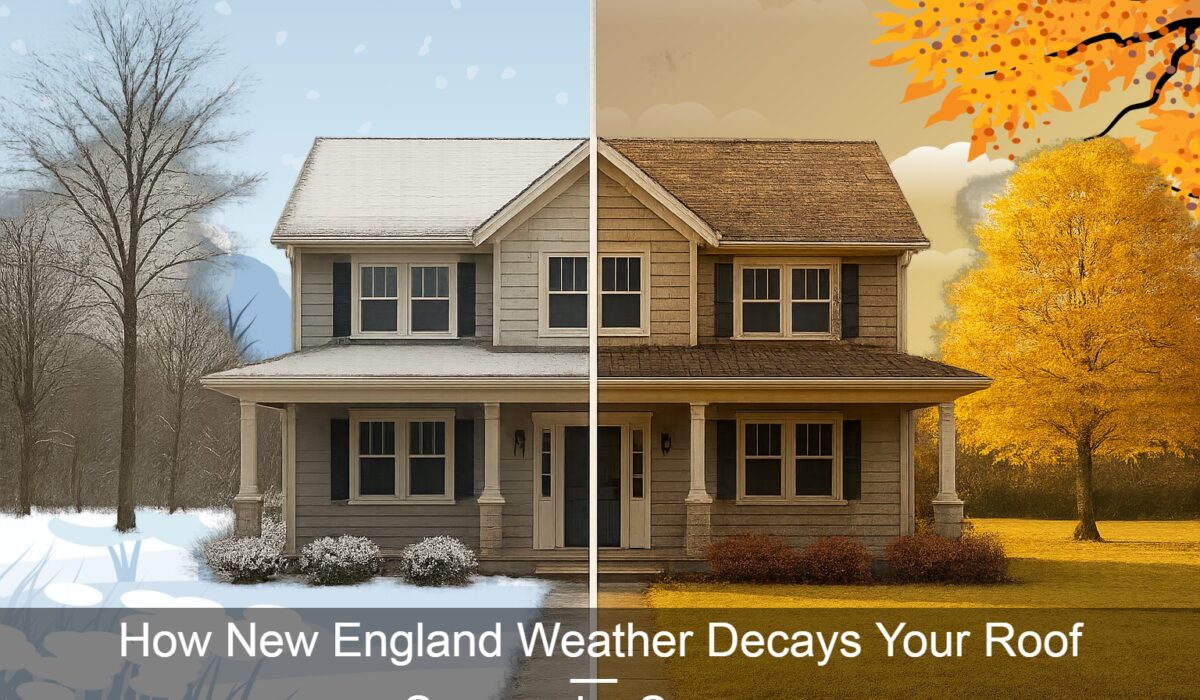
New Hampshire roofs don’t just age; they get punished! Between January ice dams that pry open eaves, spring rain that finds every weakness left by winter, summer UV that quietly bakes the life out of your shingles, and fall nor’easters that test every fastener and flashing on your home, a New England roof faces more in a single year than most roofs anywhere else in the country ever see.
That’s not an exaggeration. It’s why roofing warranties are calibrated differently for northern climates, why experienced NH contractors think about materials and installation differently than contractors in the South or Southwest, and why a roof that looks fine from the driveway can be quietly failing in ways you won’t notice until water appears on your ceiling.
After 20+ years installing and replacing roofs across Concord, Loudon, Laconia, and Central New Hampshire, we’ve seen every failure mode this climate can produce. Here’s a season-by-season breakdown of what’s actually happening to your roof — and what it means for how long it will last.
The New England Roof Damage Calendar
Every season brings a different threat. Here’s the short version before we go deep:
| ❄️ Winter | Ice dams, freeze-thaw expansion, snow load stress, ice in cracked flashing |
| 🌧️ Spring | Snowmelt infiltration, wind damage from nor’easters, debris impact, gutter overflow |
| ☀️ Summer | UV degradation, thermal shock from heat cycling, granule loss, algae and moss growth |
| 🍂 Fall | Wind from early storms, leaf debris in gutters and valleys, surprise early frost |
Winter: The Most Destructive Season for NH Roofs
If you asked most NH homeowners which season they’d most expect to damage their roof, they’d say winter — and they’d be right. But the mechanisms are more specific than most people realize. It’s not just the snow, and it’s not just the cold.
Ice Dams: What They Are and Why They’re So Destructive
An ice dam forms when heat from your living space rises into the attic, warms the roof deck, and melts the bottom layer of accumulated snow. That meltwater runs down toward the eaves — where the roof extends beyond the warm living space — and refreezes. Over time, a ridge of ice builds up along the eave line.
Here’s where the damage happens: more meltwater from above hits the ice dam and has nowhere to go. It pools behind the ice and begins to work its way under your shingles, under your underlayment, and into your roof deck. By the time it shows up as a water stain on your ceiling, you likely have saturated insulation, potentially compromised decking, and water that has been sitting inside your home for days or weeks.
The real cause of ice dams isn’t snow — it’s attic ventilation.
A properly ventilated attic stays cold, so the roof deck stays cold, so snow doesn’t melt unevenly in the first place. Poor ventilation is the root cause of most ice dam problems in NH homes. If you’re getting ice dams every winter, your attic is telling you something.
Freeze-Thaw Cycling: The Slow Structural Attack
Even in years without significant ice dam events, the simple rhythm of New Hampshire winters is damaging your roof. Every time temperatures drop below freezing and rise back above — something that can happen dozens of times between October and April — water that has seeped into micro-cracks in your shingles, flashing, or sealants expands as it freezes.
This expansion is what cracks concrete roads and pops pipes. It does the same thing on a smaller scale to the materials on your roof. Over years, those micro-cracks become real ones. Flashing lifts. Sealants fail. Granules are dislodged. The damage is cumulative and largely invisible — until it isn’t.
Snow Load and Wind-Driven Ice
Heavy, wet snow — the kind that arrives in March — puts real structural stress on your roof deck and framing. Most NH homes are built to handle this, but older homes with softer lumber or questionable framing can show stress under significant accumulation. Wind-driven ice and sleet cut into exposed edges, work under flashing, and erode granules at a faster rate than dry snow ever would.
Spring: When Winter’s Damage Becomes Spring’s Leak
Many NH homeowners discover their roof has a problem in the spring — not because spring caused it, but because the snowmelt reveals damage that’s been building all winter. Temperatures fluctuate wildly in March and April, gutters are compromised from ice weight, and rain arrives before most people have had a chance to assess what winter left behind.
Nor’easters and Wind Damage
Spring nor’easters are among the most damaging weather events for NH roofs. Sustained winds of 40–60 mph are not unusual, and gusts above that are possible. Wind damage to roofs typically shows up as:
- Lifted or missing shingles. Wind gets under the leading edge of a shingle and peels it back. Once the seal strip breaks, that shingle is vulnerable to every subsequent wind event — and the exposed nail is a direct water entry point.
- Damaged flashing. The metal flashing around chimneys, skylights, and valleys is particularly vulnerable to wind uplift. Even if a flashing doesn’t blow off entirely, repeated flexing breaks the sealant and creates gaps.
- Granule loss. High-speed wind abrades the granule surface of your shingles, accelerating their aging and reducing their UV protection.
Snowmelt and Saturated Decking
If ice dam infiltration occurred over the winter, spring melt can reveal the full extent. Saturated roof decking that has been freezing and thawing all winter may be visibly soft or delaminating. This is a structural issue, not just a cosmetic one — and it’s why early spring is the best time for a thorough roof inspection.
Summer: The Quiet Killer
Summer damage gets less attention because it’s slower and less dramatic than winter. But UV radiation and heat cycling are responsible for more premature roof aging in NH than most homeowners realize.
UV Degradation and Granule Loss
Your shingles’ granules serve two purposes: they protect the asphalt layer beneath from UV exposure, and they give the shingle its color. Every summer, UV radiation and heat break down the asphalt layer — a process that accelerates as granules are lost to weather and age. You’ll see granule buildup in your gutters and downspouts as a sign of this aging.
Once enough granules have worn off, the asphalt layer itself begins to oxidize, becoming brittle and prone to cracking. This is one of the primary markers we look for during an inspection to assess how many years a roof has left.
Thermal Shock: The Daily Expansion Cycle
On a clear summer day, a dark asphalt roof in New Hampshire can reach surface temperatures of 150–170 degrees Fahrenheit. At night, that same roof cools to ambient temperature. This daily expansion and contraction — thermal shock — creates stress at every fastener, seam, and flashing connection on your roof. Over years, it loosens nails, fatigues sealants, and contributes to the same kind of micro-cracking that freeze-thaw cycles accelerate in winter.
Algae, Moss, and Biological Growth
New Hampshire’s humid summers are ideal conditions for roof algae (the black streaking you see on north-facing slopes) and moss growth, which is particularly common in shaded areas. Algae is primarily aesthetic, but moss is structurally problematic — its root systems lift shingles and hold moisture against the roof surface, accelerating decay. Left untreated, a moss problem becomes a replacement conversation.
Algae-resistant shingles are worth the conversation.
Owens Corning’s Duration and TruDefinition shingle lines include algae-resistant copper-infused granules — a meaningful upgrade for NH homes in wooded or shaded locations. Ask us about it during your estimate.
Fall: The Last Chance Window — and a Threat of Its Own
Fall is the season most NH homeowners think about their roofs — and for good reason. It’s the last opportunity to make repairs before winter arrives. But Fall also delivers its own share of damage.
Wind Events and Early Storms
September and October can bring strong wind events, tropical remnants, and early nor’easters that hit before most homeowners have finished their fall prep. Any shingle that was weakened over summer is vulnerable now. Any flashing that was lifted or re-sealed poorly will be tested.
Leaf Debris and Gutter Failure
Gutters clogged with leaves are a direct cause of water backup and ice dam formation. When water can’t drain off the roof efficiently, it pools at the eave line — exactly where it doesn’t belong. A blocked downspout in November is an ice dam waiting to form in January.
Beyond gutters, debris accumulating in roof valleys — the low points where two roof planes meet — holds moisture against the surface and accelerates decay at one of the most vulnerable spots on any roof.
The Inspection Window
October is the single best month to have your roof inspected in New Hampshire. You’re past the summer heat and UV peak, before the ice and snow arrive, and any issues identified can realistically be addressed before winter. If you haven’t had your roof looked at in the last three to five years — or after any significant storm event — fall is the time.
What This Means for Your Roof’s Lifespan
A standard architectural asphalt shingle roof is typically rated for 25–30 years under normal conditions. In New Hampshire, however, “normal conditions” don’t really apply. Harsh winters, heavy snow, freeze-thaw cycles, moisture, and potential ice damming can all shorten a roof’s lifespan.
For a high-quality Owens Corning architectural shingle roof, such as the Duration® series, homeowners may see a lifespan of 25 to 50 years when the roof is installed correctly, properly ventilated, and consistently maintained. While standard shingles may last closer to 15–25 years in northern climates, premium Owens Corning shingles can often reach 30–40+ years, especially with features like SureNail® Technology.
In practical terms, a well-installed New Hampshire roof might last 20–25 years or longer, while a poorly installed roof — or one that never receives routine maintenance or inspections — can fail significantly sooner.
The factors that matter most:
- Attic ventilation. Proper attic ventilation is one of the biggest factors in roof longevity in cold climates. It helps prevent ice dams and reduces heat cycling that can age shingles from below.
- Installation quality. Correct underlayment, ice and water shield at the eaves, proper ventilation, and accurate nailing patterns are essential. Even high-quality shingles can fail early if they are installed incorrectly.
- Shingle type and material quality. Architectural or dimensional shingles outperform 3-tab shingles, which may only last 12–18 years in northern climates. Owens Corning products are designed to handle New England’s thermal cycling, moisture, and weather challenges.
- Weather exposure. New Hampshire’s harsh winters, heavy snow, and potential ice damming can shorten lifespan and may lead to replacement around 15–25 years when damage is significant.
- Maintenance and inspection. Roofs that receive periodic inspections, minor repairs, gutter cleaning, and moss removal last significantly longer than roofs that are ignored until a major failure occurs.
Warranty & Durability
Owens Corning offers a Limited Lifetime Warranty on many shingle products, and the Duration line features 130 MPH wind resistance. These durability features can help extend roof performance when paired with proper installation and ongoing maintenance.
In New Hampshire, your roof’s lifespan depends on more than the shingles themselves. It comes down to installation, attic ventilation, weather resilience, material quality, and ongoing care. Done right from the start, an Owens Corning roof can protect your home for decades.
What NH Homeowners Should Do
You can’t stop New England weather. But you can make sure your roof is built and maintained to handle it. Here’s what we recommend:
- Get a professional inspection every three to five years, and after any significant storm — hail, sustained high winds, or heavy wet snow events.
- Clear gutters in late October and again in early spring. It’s one of the highest-leverage maintenance tasks a homeowner can do.
- Have your attic ventilation evaluated if you’re seeing ice dams regularly. The fix is often straightforward and dramatically extends roof life.
- Don’t ignore granule loss in your gutters, moss growth on north-facing slopes, or curling at the edges of your shingles. These are early warnings, not cosmetic issues.
- If your roof is approaching 20 years old, start planning — not because you necessarily need to replace it tomorrow, but because making that decision proactively gives you time to choose the right contractor and materials, not whoever can fit you in after an emergency.
If you want to know more about what a professional roof inspection actually covers, our guide on what questions to ask during an estimate is a good place to start. And if you’re already past the inspection stage and planning a replacement, our installation day guide walks you through exactly what to expect.
| Schedule a Free Roof Inspection Before Winter Arrives |
| Jasmor Roofing & Contracting has been protecting NH homes across Concord, Loudon, Laconia, and Central New Hampshire for over 20 years. As an Owens Corning Platinum Preferred Contractor, we install materials engineered for this climate — and we back our work with warranty coverage you can count on. |
| Call (603) 961-0335 or request your free estimate online → https://jasmorprop.com/contact |