If you’ve gotten more than one roofing estimate, you’ve probably already noticed something strange: the numbers can vary by thousands of dollars on the same roof. Same house, same shingles, same scope of work — wildly different prices.
Sometimes that’s because contractors are quoting different materials. Sometimes it’s because someone is cutting corners. But more often than homeowners realize, it’s because the contractor never accurately measured the roof in the first place.
A roof estimate is only as honest as the measurements behind it. Get the square footage wrong by 10%, miss a hip or a valley, or skip the pitch calculation, and the price you’re quoted has almost nothing to do with the price the job will actually cost. That’s how homeowners end up with mid-project change orders and surprise overages — the kind of phone call no one wants to get.
At Jasmor Roofing & Contracting, we built our estimating process around a simple principle: the number we give you on day one should be the number you pay on the last day. To do that, we use a combination of aerial measurement technology, on-site verification, and 20+ years of NH-specific field experience. Here’s exactly how it works.
Why a Few Inches of Measurement Error Costs Thousands
Most NH homeowners assume a roof estimate is a rough number — a ballpark figure that everyone knows is approximate. It shouldn’t be. A roof is made up of specific, measurable components, and every one of them affects price:
- Total roof area in squares (1 square = 100 sq. ft. of roofing surface)
- Number of ridges, hips, and valleys (each requires specialty shingles or flashing)
- Length of eaves and rakes (drives starter strip and drip edge quantities)
- Pitch / slope (affects labor cost, safety equipment, and waste factor)
- Penetrations — chimneys, vents, skylights, and pipe boots (each needs flashing)
Underestimate the square footage and you’ll run out of shingles mid-job. Overestimate it and you’re paying for materials you don’t need. Get the pitch wrong and the labor budget collapses. The numbers matter — and they matter to the inch.
This is where we lean on technology to do what the human eye can’t do accurately from the ground.
EagleView: The Aerial Measurement Standard
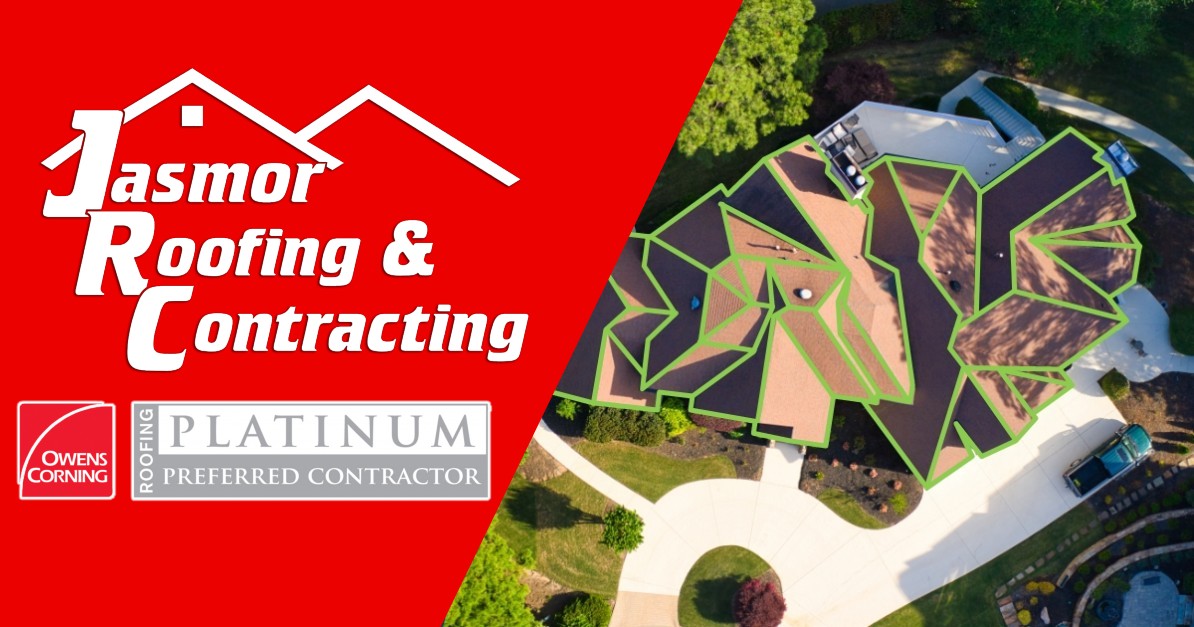
EagleView is the technology backbone of every estimate we produce. If you haven’t heard of it, here’s the short version: EagleView is an aerial imagery company that uses fixed-wing aircraft and proprietary photogrammetry software to produce engineered measurement reports of any roof in the United States.
When we pull an EagleView report on your home, here’s what we get back — usually within hours:
- Total roof area, broken down by individual facet (every flat plane of your roof is measured separately)
- Exact pitch of every facet, to the degree
- Linear footage of every ridge, hip, valley, eave, and rake
- 3D wireframe diagrams showing exactly how your roof is shaped
- Top-down, north-, south-, east-, and west-facing views of your home
The reports are engineered to within a 99%+ accuracy tolerance, and they’re used by roofing manufacturers, insurance adjusters, and contractors nationwide. When we say we know the exact square footage of your roof before we ever climb a ladder, we mean it.
Why we pay for EagleView when we could just eyeball it
Most contractors don’t pay for an EagleView report on every estimate — they’re not free, and a lot of smaller operations skip the cost. We pay for it because the alternative is hand-measuring a roof from the ground with a tape measure and best guesses, and the accuracy gap is enormous. A few hundred dollars in measurement cost saves homeowners thousands in surprise overages later. We think that’s the trade worth making.
Why We Don’t Stop at the EagleView Report
Here’s the thing about aerial reports: they’re incredibly accurate at measurement, but they can’t tell us everything we need to know to give you an honest estimate. EagleView can show us your roof’s geometry. It can’t show us that the soffit is rotted, that a previous contractor nailed shingles through the underlayment incorrectly, or that your attic has no ventilation.
That’s why every Jasmor estimate involves three sources of verification — not just one.
Source 1: The EagleView aerial report
Generated before we visit. Gives us the precise geometry, square footage, pitch, and component lengths.
Source 2: On-site physical inspection
Our estimator visits your home, walks the property, and (when conditions allow) climbs the roof itself. We’re looking for:
- Existing damage that won’t show up in aerial imagery — soft decking, lifted shingles, granule loss, popped nails
- Flashing condition around chimneys, skylights, and walls
- Soffit, fascia, and gutter condition
- Attic ventilation — intake, exhaust, and any signs of moisture damage
- Anything specific to your home that affects scope of work
Source 3: Cross-verification against the EagleView numbers
Before we hand you a quote, we cross-check the EagleView measurements against what our estimator saw on-site. If anything doesn’t match — a facet that looks different in person, an addition that wasn’t captured in the aerial imagery, a feature the report missed — we flag it and re-measure manually before the estimate goes out.
This is the difference between an estimate that’s accurate on paper and one that survives contact with reality. Both matter.
What This Means for You as a Homeowner
All this technology is invisible from your end — you just get an estimate that’s a single number, on a single sheet of paper, that doesn’t change. But here’s what’s actually happening behind that number:
- No surprise overages. Because we measured accurately the first time, we’re not coming back to you mid-project saying ‘turns out the roof is bigger than we thought.’ The number we quote is the number you pay, barring genuinely unforeseen issues like rotted decking — which we’ll always show you in person before any work proceeds.
- Accurate material orders. We order exactly what your roof needs, which means less waste sitting in your driveway and a tighter timeline from estimate to install.
- Faster turnaround. Because EagleView reports arrive within hours, we can quote roofs accurately without long delays — even when the weather doesn’t cooperate for an immediate site visit.
- Apples-to-apples comparison. If you’re comparing our estimate against another contractor’s, you can ask them whether they pulled an EagleView report or measured from the ground. The answer tells you a lot about how reliable their number is.
Beyond Measurements: The Other Technology in Your Estimate
EagleView is the most visible piece of our process, but it’s not the only technology we use. A modern roofing estimate involves more than just measurements.
Design EyeQ Visualizer
Choosing a shingle color is one of the most personal decisions in any roof replacement — and one of the hardest to make from a sample swatch. Owens Corning’s Design EyeQ tool lets you upload a photo of your actual home and see how different shingle colors and styles will look on your roof. We walk every homeowner through this tool as part of the estimate process so you can make an informed choice with confidence.
Material system warranty modeling
Owens Corning’s full-system warranty depends on installing the entire shingle system together — not just the shingles, but the starter strips, underlayment, ridge caps, and ventilation. As a Platinum Preferred Contractor, we use Owens Corning’s warranty modeling tools to make sure the materials we quote you actually qualify for the warranty we’re promising. A lot of contractors quote ‘lifetime warranty’ shingles without including the system components needed to back it. We don’t.
Drone imagery for difficult roofs
On steep, slate, or multi-story roofs where a physical walkthrough creates safety risk, we use drone imagery to verify condition close-up without putting our estimator in a dangerous position. You get the same accuracy, with none of the safety compromises that lead to insurance issues with less-prepared contractors.
What to Watch For in Other Estimates
If you’re collecting multiple bids — and you should be — here’s how to tell whether a contractor is measuring accurately or guessing:
- Ask whether they pulled an aerial measurement report (EagleView or similar). If the answer is ‘no, I just eyeballed it’ or ‘I’ll measure it with a tape from the ladder,’ that estimate is a guess.
- Ask how they calculated the pitch. Pitch dramatically affects price — there should be a specific number, not a shrug.
- Watch for round numbers. A quote of exactly ‘$15,000’ or ‘$20,000’ is almost always a guess that was rounded to a number that sounded good. Real estimates have odd numbers because real measurements produce odd numbers.
- Ask what’s included if the deck needs repair. Honest contractors will give you a per-sheet price up front. Dishonest ones will tell you ‘we’ll handle it’ and then surprise you with a four-figure change order.
The hidden cost of an inaccurate estimate
We routinely talk to homeowners who chose a cheaper bid from another contractor and ended up paying more than our original estimate after change orders and overages were added on. A low quote is only valuable if it’s the price you actually pay at the end. That’s why we put so much work into making sure the number we give you on day one is the number that holds.
The Bottom Line: Estimates Should Be Engineered, Not Eyeballed
Your roof is one of the most expensive systems in your home, and the estimate you get sets the financial expectations for a project that can run into the tens of thousands of dollars. It deserves more than a tape measure and a tablet.
When you call us for a free estimate, here’s what happens: we pull your home’s aerial data, we send an estimator out to walk the property, we cross-check the two against each other, and we hand you a quote with measurements and material details you can verify yourself. No mystery. No surprise overages. Just an estimate built on actual data.
If that sounds like the way an estimate should work — because it is — let’s get yours scheduled.
| Get a Free, Accurate Roof Estimate from Jasmor Roofing |
| EagleView aerial measurement. On-site verification. A quote that doesn’t move. Serving Concord, Loudon, Laconia, and Central NH for 20+ years as an Owens Corning Platinum Preferred Contractor. |
| Call (603) 961-0335 or request your free estimate online → https://jasmorprop.com/contact/ |