
Ask most homeowners what keeps water out of their house and they’ll point at the shingles. That’s not wrong — shingles do the visible work. But shingles are the last line of defense, not the only one, and if you were to walk the perimeter of your roof and point to the parts doing the most invisible work, you’d end up pointing at three components almost no one thinks about: your soffit, your fascia, and your ridge vent.
Together, these three pieces form a system that manages every ounce of air and moisture your roof encounters. When they work correctly, you stay dry, your shingles last their full lifespan, and your attic stays healthy. When one of them fails — and they fail more often than most homeowners realize — the consequences show up months or years later as leaks, ice dams, mold, or a prematurely aged roof.
After 20+ years of replacing NH roofs, we’ve learned that a huge percentage of “roof problems” homeowners describe on the phone aren’t shingle problems at all. They’re ventilation and edge-detail problems. Here’s how the soffit-fascia-ridge system actually works, what happens when it doesn’t, and how to spot trouble before it costs you a roof.
The Three Parts of the System — Explained Simply
Before we talk about how they work together, it helps to know what each piece is and where to find it on your house. If you’ve never looked closely, walk outside and glance up at the edge of your roof. All three parts are visible from the ground.
| Soffit |
| The vented underside of your roof overhang |
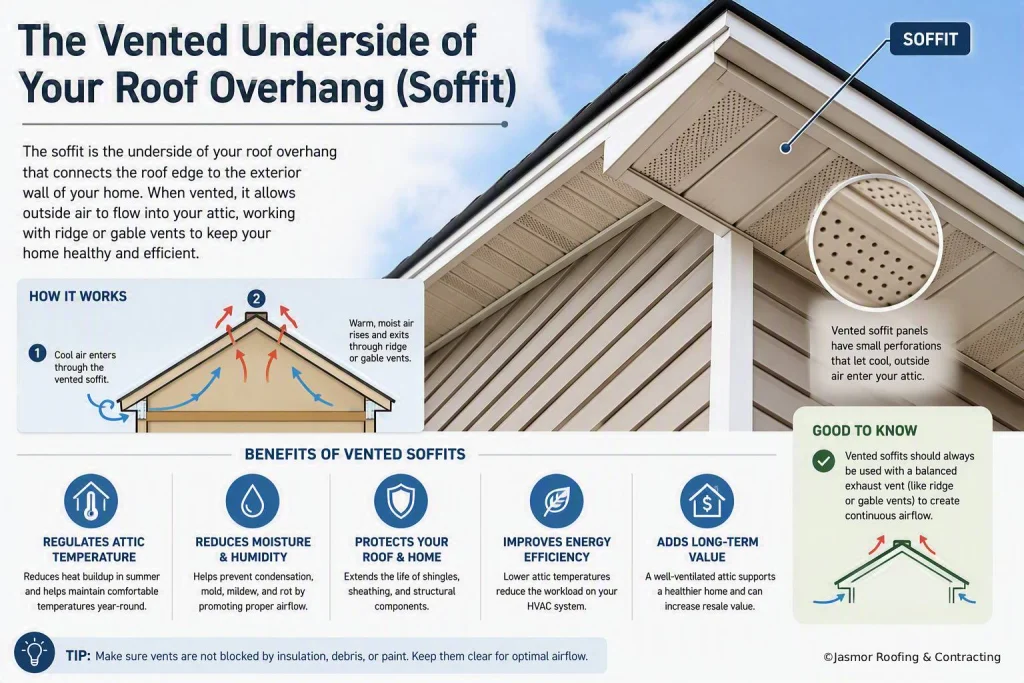
The soffit is the horizontal underside of the roof overhang — the panel you see when you stand under your eaves and look straight up. It’s usually made of aluminum, vinyl, or wood, and it runs the length of every eave on your home.
The soffit’s most important job is invisible: it’s the intake for your attic’s ventilation system. Look closely and you’ll see either continuous perforations along its length or individual vents spaced every few feet. Those openings pull cool outside air up into your attic space, which is the first half of the air exchange that keeps your roof healthy.
A soffit without ventilation is just decorative trim — and unfortunately, that’s what a lot of older NH homes have. If we lift a soffit panel during an inspection and find no perforations or the openings are painted or clogged shut, we’ve usually already found the root cause of whatever else is going wrong.
| Fascia |
| The vertical board along your roof edge |
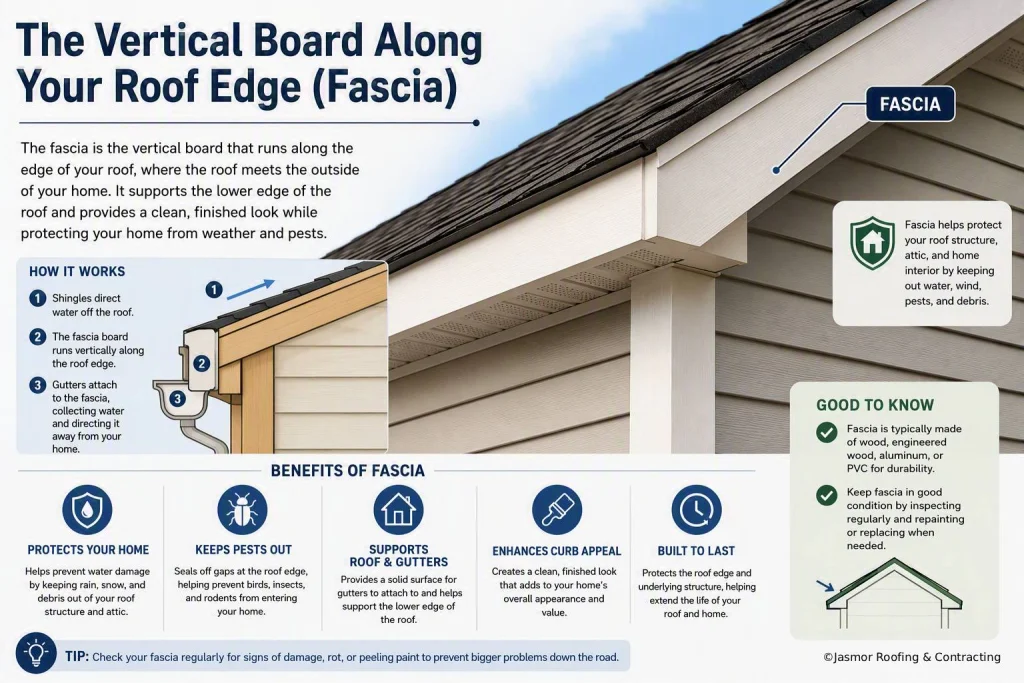
The fascia is the vertical band that runs horizontally along the outside edge of your roof — the board you see straight-on from the driveway when you look at the roof line. It’s what holds up the gutter, what caps the ends of the rafters, and what visually finishes the roofline of your home.
Fascia’s role is structural and protective. It:
- Provides a mounting surface for gutters (which channel water away from the foundation)
- Seals the ends of the rafters against wind-driven rain, insects, and small animals
- Supports the lowest edge of the roofing system — including the drip edge and starter shingle course
- Ties the whole roof edge together visually and structurally
When fascia rots — usually from water backing up behind an overflowing gutter — the whole edge of the roof loses its structural anchor. Gutters sag, drip edge lifts, and the first shingle course starts to fail. Fascia damage is one of the most common repair calls we get, and it’s almost always a warning sign that gutter maintenance has fallen behind.
| Ridge Vent |
| The exhaust at the peak of your roof |
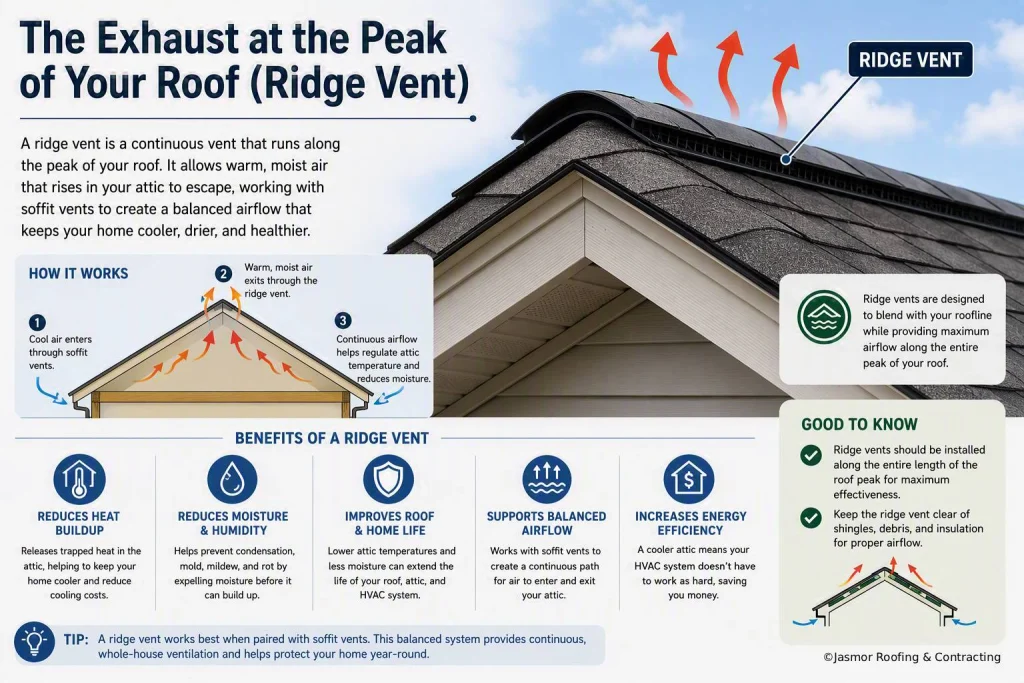
The ridge vent is a low-profile ventilation strip that runs along the very peak (the ridge) of your roof, hidden under the ridge cap shingles. From the ground, most homeowners don’t even know it’s there — it looks like the rest of the ridge. But the entire top edge of your roof, where the two slopes meet, has been cut open and covered with an engineered baffle that lets hot air out while keeping rain, snow, and insects from getting in.
The ridge vent is the exhaust half of your attic’s ventilation system. Because hot air rises, air heated in your attic naturally moves upward and needs somewhere to escape. The ridge vent provides that exit path, running continuously along the highest point of the roof so the entire attic volume can breathe.
Not every roof has a ridge vent. Older NH homes often used gable vents (the triangular vents in the peaks of end walls), box vents (small individual roof vents), or turbine vents (the spinning ones) instead. Ridge vents are the modern standard because they provide continuous exhaust across the entire ridge line — but retrofitting one requires cutting the roof deck, which is a job that has to be done right or it becomes a leak point.
How They Work Together: Passive Convection in Your Attic
Here’s the elegant part. The soffit-fascia-ridge system doesn’t have any moving parts. It doesn’t need a fan, doesn’t use electricity, and doesn’t require any homeowner action. It works because of physics.
Warm air rises. When your attic heats up — from the sun beating on your shingles in July, or from warm household air leaking up through your ceiling in January — that heated air moves toward the highest point in the space. If there’s an exit at the ridge (the ridge vent), the hot air escapes through it. As it escapes, it creates a slight negative pressure inside the attic. That pressure drop pulls cooler outside air in through the soffit vents at the bottom. The result is a continuous, silent convection loop:
- Cool air enters at the soffits (low, along the eaves)
- Air rises through the attic, absorbing heat and moisture
- Hot, moist air exhausts through the ridge vent (high, at the peak)
- The cycle repeats, 24 hours a day, in every season
Fascia isn’t part of the airflow itself — its job is to protect the edge of the system from water infiltration. Together, the three components create a roof edge that breathes without leaking. Air moves freely. Water doesn’t get in. That’s the whole design.
| Why intake AND exhaust both matter You need both halves of the system, in balance, for it to work. A ridge vent without functional soffit intake is like trying to drink through a straw with your finger over the top — nothing moves. Same the other way around: soffit vents with no exhaust path do nothing. This is one of the most common issues we find on NH homes: a beautiful ridge vent was installed years ago, but the soffits are either non-vented or the insulation was pushed against them, sealing them shut. The system looks correct from the outside but functionally does nothing. Both halves have to be open and clear. |
How This System Actually Keeps You Dry
The obvious way a roof keeps water out is by shedding it — shingles overlap, water flows downhill, gutters catch it, done. But most water damage on NH homes doesn’t come from water landing on the roof. It comes from water that’s already inside the house.
Here’s what we mean. Your family produces water vapor constantly — from showers, cooking, breathing, dishwashing, laundry, and simply existing in a heated space. In the winter, that warm, humid indoor air is drawn upward by natural convection and small air leaks, and it ends up in the coldest part of your building: the attic.
When that warm, moist air hits the cold underside of your roof deck, it condenses — the same way water beads on a cold glass on a summer day. Without ventilation, that condensation has nowhere to go. It soaks into the wood, saturates the insulation, promotes mold, and can eventually drip back down onto your ceiling, showing up as a mysterious “leak” that no roofer can find because it isn’t coming from outside.
The soffit-fascia-ridge system prevents this by continuously flushing that moist air out of the attic before it can condense. Cold, dry outside air comes in the soffits. Warm, moist attic air exits the ridge. The interior surfaces stay dry. Wood doesn’t rot, insulation doesn’t get soaked, and mold doesn’t get a foothold.
This is what “keeps you dry” means in the context of ventilation. It’s not just about keeping rain out. It’s about keeping your own household moisture from being trapped where it can do damage.
What Happens When One Piece Fails
Each part of the system is dependent on the others. When one component fails, the damage doesn’t stay isolated — it cascades through the roof.
When the soffit fails (blocked intake)
Blocked or non-vented soffits kill the intake side of the loop. Without airflow in, hot air can’t escape at the ridge either — the whole system stalls. In summer, attic temperatures can climb to 140°F+ and start cooking the shingles from below, dramatically shortening their life. In winter, moist air stagnates and condenses. Ice dams form because the attic heat that would normally escape at the ridge instead melts the underside of the snow on your roof.
When the fascia fails (rot or gap)
Rotted fascia usually means water has been backing up behind the gutter for a long time. As the wood loses structural integrity, the gutter starts to sag or pull loose from the house, which makes the backup worse — a feedback loop that ends with water pouring behind the gutter and into the wall of the house. Rotted fascia also opens gaps where insects, squirrels, and bats get into the attic. Once fascia rot starts, it accelerates fast, and the damage extends into the roof deck within a season or two.
When the ridge vent fails (leak or clog)
A poorly installed or aging ridge vent can start to admit wind-driven rain, snow infiltration, or ice. Leaks at the ridge are among the most confusing for homeowners because water enters at the top of the roof and appears at any point along the way to the ceiling — sometimes yards from the actual entry point. Blocked ridge vents (usually from bird nests or snow ice-up) shut down exhaust and create the same stagnation problem as blocked soffits.
Signs of Trouble You Can Spot From the Ground
You don’t need to get on the roof to notice ventilation and edge-detail problems. Most of them show up in ways you can see from your driveway. Take a slow walk around the house and look for:
- Peeling or blistered paint on the soffit or fascia — usually a sign of trapped moisture from behind
- Visible rot, soft spots, or discoloration on the fascia board, especially near the corners of the house
- Sagging gutters or gutters pulling away from the fascia
- Icicles or ice dams forming at the eaves in winter — a red flag for attic ventilation failure
- Streaks or staining on the exterior below the eaves, indicating overflow
- Insects, birds, or bats entering under the eaves — usually via rotted or gapped fascia
- Visible sagging or waviness in the roof line at the peak — sometimes a sign of ridge vent damage
- Mold spots or discoloration on the ceiling directly below the attic — condensation damage from inside
If you see any of these, don’t panic — but don’t ignore them either. Each one is a symptom, not a cause. A trained eye can trace the visible sign back to the root problem in the system, and early intervention is dramatically less expensive than waiting until water damage reaches the interior of the home.
Why This System Matters More in New Hampshire
Ventilation matters everywhere, but NH homes stress the system harder than almost any other climate in the country. Here’s why:
- Winter humidity load. NH homes are sealed tight against the cold, which traps interior humidity. That moist indoor air has fewer escape paths than in milder climates, so the ventilation system has to move more moisture.
- Ice dam risk. The soffit-fascia-ridge system is the single biggest determinant of whether your home will develop ice dams. Well-vented attics stay cold enough that snow melts uniformly from the top down — badly vented attics create the melt-refreeze pattern that forms damaging ice at the eaves.
- Freeze-thaw cycling. NH goes through 80–100 freeze-thaw cycles per winter. Any water trapped in the roof edge repeatedly freezes and expands, then thaws and contracts, causing accelerated damage to soffit, fascia, and deck.
- Long heating season. Roughly seven months of heating means seven months of pushing warm, moist interior air toward the attic. That’s a lot of load on the ventilation system compared to homes in the South, which rarely deal with condensation issues at all.
This is why proper ventilation is baked into every full roof replacement we do. If we’re tearing off your old roof and we notice the ventilation system isn’t up to standard, we’ll show you exactly what we’re seeing and walk you through what it will take to fix it. Fixing ventilation during a replacement is a fraction of the cost of retrofitting it later.
When It’s Time to Call a Professional
A few situations move a soffit-fascia-ridge issue from “keep an eye on it” to “call somebody now”:
- Any visible rot in the fascia — this doesn’t heal, it only spreads
- Repeat ice dam formation in the same spot two winters in a row
- Water stains appearing on ceilings during humid summer weather (not just after rain)
- Any evidence of animal entry through the eaves
- A ridge that visibly bows, dips, or shows separation from the shingles
- You’re planning a roof replacement — this is the moment to correct any ventilation deficiencies at a fraction of the cost of doing it later
Jasmor’s roof inspections include a full evaluation of the soffit, fascia, and ridge ventilation on every home we visit — not just the shingles. Because most “roof problems” aren’t actually shingle problems, and finding the real cause is what makes the difference between a repair that lasts and one you’ll be calling us back about.
If you’ve noticed any of the signs in this article, or if it’s been more than a few years since anyone actually looked at your roof’s ventilation and edge details, we’d be glad to come take a look. It’s free, and it’s one of the fastest ways to catch a small problem before it becomes an expensive one.
| Schedule a Free Roof & Ventilation Inspection |
| Every Jasmor inspection includes soffit, fascia, and ridge vent evaluation — not just shingles. Owens Corning Platinum Preferred Contractor serving Concord, Loudon, Laconia, and Central NH for 20+ years. |
| Call (603) 961-0335 or request your free estimate online |