Here’s a number that shocks most homeowners: you can spend $20,000+ on a top-tier roof replacement, use the best shingles on the market, and still cut that roof’s life in half if the attic underneath it can’t breathe.
It’s true. Attic ventilation is the single most under-discussed variable in roof longevity — and in NH, where extreme temperature swings and long heating seasons stress the ventilation system hardest, it’s also the variable that most often decides whether a roof reaches its full lifespan or fails ten years early.
The problem is that no homeowner ever goes up in the attic. It’s dark, uninsulated, full of blown fiberglass, and generally unpleasant. So the space that determines whether your $20,000 investment lasts 15 years or 30 sits invisible above your head, quietly cooking or drowning depending on the season, until damage shows up somewhere it shouldn’t.
This is the article we wish every homeowner would read before they get a roof replacement quote. It’s about what happens in an attic that can’t breathe, how to tell if yours is in trouble, and what it takes to fix. If you haven’t read our companion post on how soffit, fascia, and ridge vents form the ventilation system in the first place, that’s Soffit, Fascia, and Ridge Vents: How They Work Together to Keep You Dry — it pairs directly with this one.
What “Suffocating” Actually Means Up There
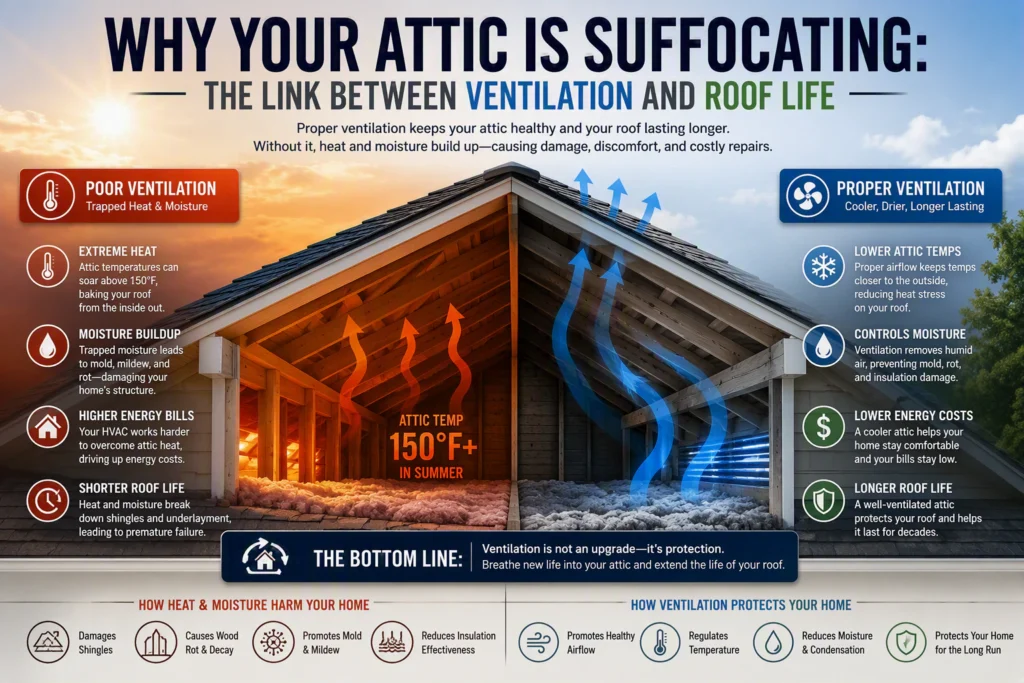
A suffocating attic isn’t dramatic. There’s no visible smoke, no alarm, no obvious sign. It’s just an enclosed space where the air isn’t moving — where the soffit intake is blocked, the ridge exhaust is inadequate or missing, or the two are so out of balance that the natural convection loop can’t establish itself.
When air stops moving in your attic, two things happen. Both of them destroy roofs.
Problem 1: Heat can’t escape
Your roof surface can hit 150–170°F on a July afternoon in NH. That heat radiates downward into the attic. In a properly vented attic, that hot air rises and exits at the ridge, replaced by cooler outside air pulled in at the soffits. Attic temperature stabilizes 15–25°F above outside temperature.
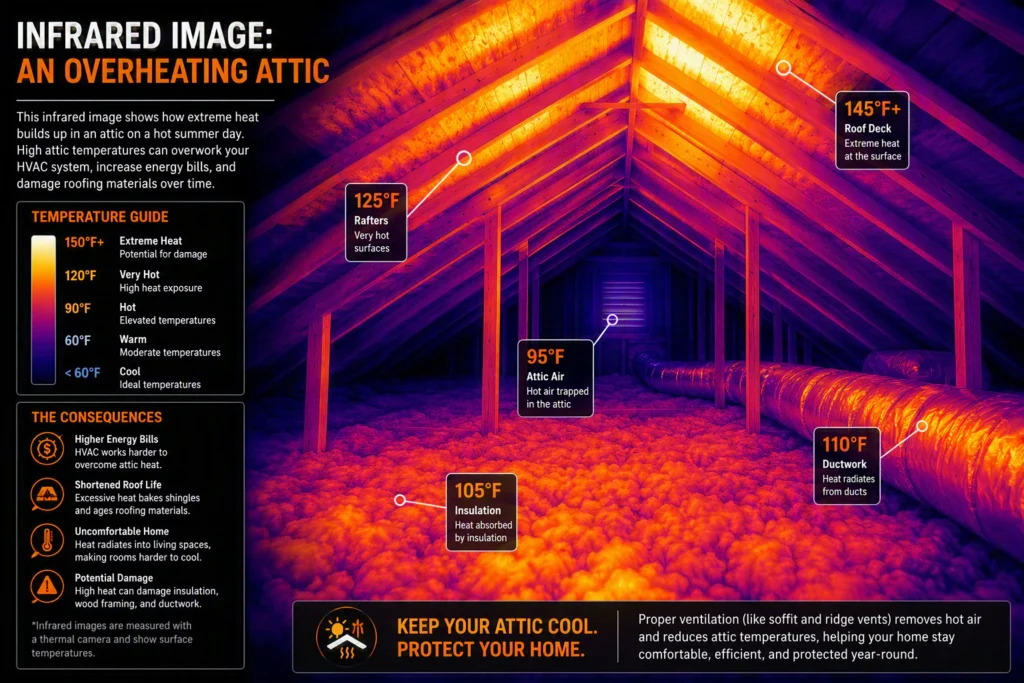
In a suffocating attic, none of that happens. The heat just builds. Attic temperatures reach 140–160°F. That heat cooks the underside of the shingles — and the underside is where most of the damage occurs, because heat weakens the asphalt bond and accelerates chemical breakdown from a direction the manufacturer never designed for.
Problem 2: Moisture can’t escape
Your household produces gallons of water vapor daily. Warm, humid air rises through your ceiling — through recessed lights, attic hatches, plumbing penetrations, and any other opening — and ends up in the attic. In a properly vented attic, that moisture is carried out with the exhaust air before it can settle.
In a suffocating attic, moisture accumulates. In winter, it condenses on the cold underside of the roof deck as frost or water. Over months, it saturates the deck, promotes mold and rot on the sheathing, ruins the insulation, and eventually drips down through the ceiling as “leaks” that no roofer can trace to a source outside the house.
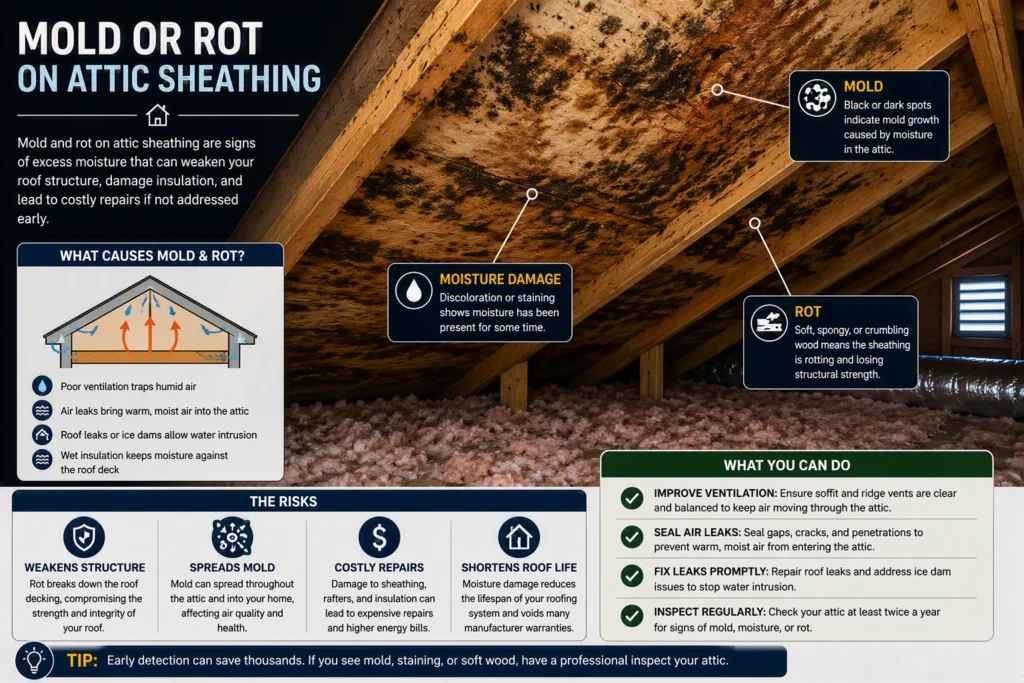
Either problem, running for years, will cut a roof’s life in half. Both problems running simultaneously — which is the norm in a poorly vented NH attic — can end a roof’s life in a decade.
The Lifespan Math: How Bad Ventilation Kills Your Roof
A quality architectural shingle — the Owens Corning Duration line, for example — is engineered for a 30-year functional lifespan when installed on a properly vented roof, with a limited lifetime warranty backing the material.
Here’s what actually happens to that 30-year lifespan under different attic conditions:
| Attic Ventilation Condition | Realistic Roof Lifespan |
|---|---|
| Properly balanced (intake + exhaust) | Full manufacturer rating — 25–30+ years |
| Undersized ventilation (adequate but marginal) | About 20–25 years |
| Exhaust only (ridge vent, blocked soffits) | About 15–20 years — heat/moisture stall |
| Intake only (no ridge or roof exhaust) | About 12–18 years — heat accumulates |
| No functional ventilation at all | 10–15 years, sometimes less |
These aren’t marketing numbers — they’re patterns we see over 20+ years of tearing off roofs and inspecting the deck underneath. When we open up a roof that failed at 12 years on a home with allegedly “good” shingles, we know before we even look at the attic that we’re going to find a ventilation problem. And we almost always do.
| The warranty catch most homeowners don’t know about Nearly every major shingle manufacturer — including Owens Corning — requires proper attic ventilation as a condition of their warranty. If your roof fails prematurely and the manufacturer’s inspector finds inadequate ventilation, the warranty claim can be denied. That’s why we insist on evaluating and correcting ventilation issues as part of every full roof replacement. A roof warranty is only worth what the conditions attached to it will let you actually claim. |
The Four Failure Modes of a Suffocating Attic
If we could set up cameras inside a poorly vented NH attic and time-lapse a full year, we’d catch four distinct failure modes — each linked to specific seasons and each contributing to premature roof death. Here’s what would show up on the footage.
Failure Mode 1 — Summer: Cooking the Shingles from Below
Peak-summer attic temperatures in a suffocating space can hit 160°F. Asphalt shingles lose their oils and flexibility when heated repeatedly to this range. The bond between the mat and the granules weakens. Granule loss accelerates, exposing the mat to UV that then breaks it down further. The shingle ages internally, from a direction it wasn’t engineered to defend against, and its remaining useful life shortens with every summer.
Failure Mode 2 — Winter: Ice Dams at the Eaves
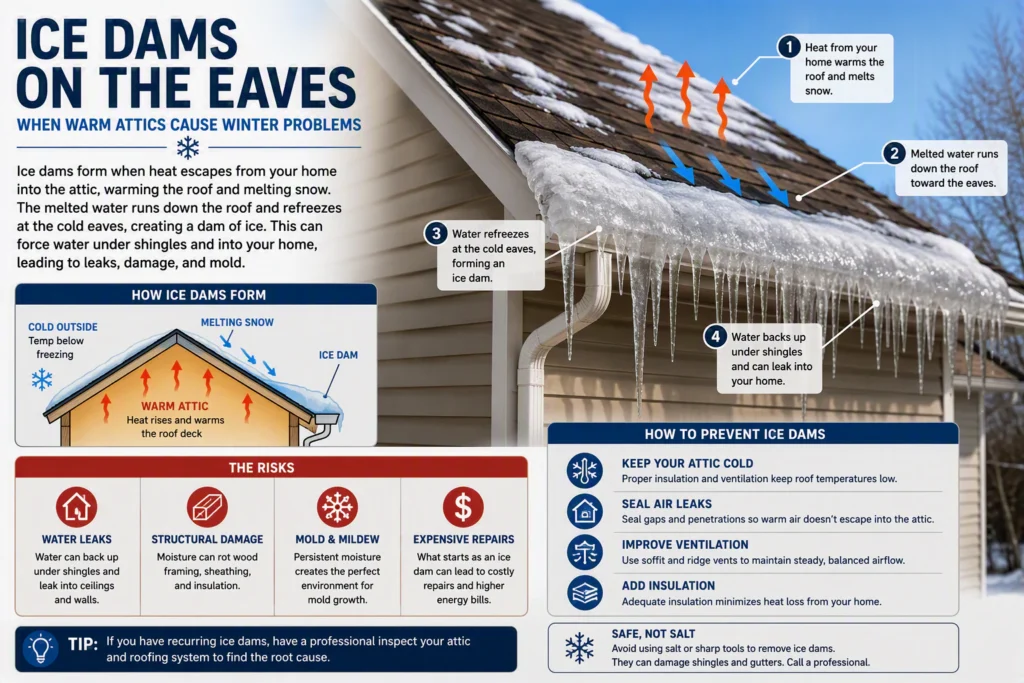
This is the failure NH homeowners see most often, even if they don’t recognize its origin. A suffocating attic gets warm at the peak (because it’s collecting heat from the house below). That warmth melts snow on the upper roof. The meltwater runs down the roof and refreezes when it hits the colder overhang — which stays cold because the eaves are the least insulated part of the roof. That refreezing forms an ice dam that grows for weeks, prying up shingles, backing water under the deck, and eventually causing leaks into the exterior wall or ceiling below. Ice dams are almost always a ventilation problem, not a roof problem.
Failure Mode 3 — Winter: Condensation on the Deck Underside
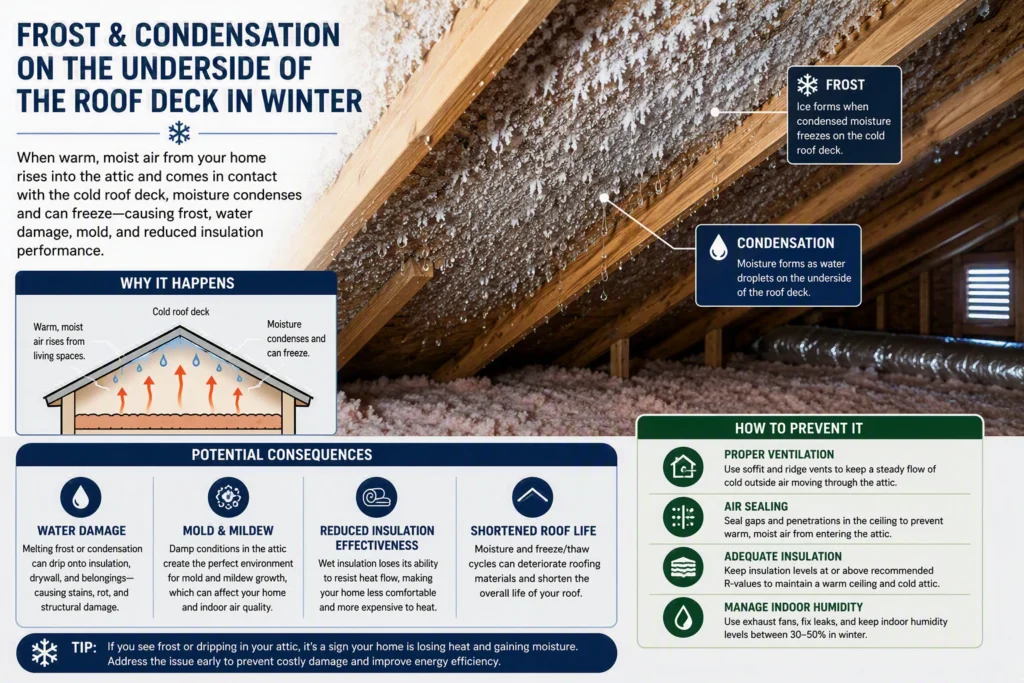
Household humidity migrates upward, hits the cold underside of the roof deck, and condenses as frost or water. Left alone through a winter, this soaks the OSB or plywood decking, promotes mold and mildew, and can lead to actual rot in a few seasons. Homeowners discover this only when the roof gets replaced and the tear-off exposes black, spongy sheathing that has to be replaced entirely — a several-thousand-dollar addition to the replacement cost that wouldn’t have been necessary with proper ventilation.
Failure Mode 4 — Year-Round: Insulation Degradation
Wet fiberglass insulation loses most of its R-value. So when moisture accumulates in a suffocating attic, your insulation stops insulating — which means more heat escapes into the attic in winter, which means more melt and refreeze at the eaves, which means more moisture in the attic, which means more insulation degradation. It’s a feedback loop that costs you money on heating bills every month and takes years off the roof at the same time.
Signs Your Attic Is Suffocating (Without Going Up There)
You don’t have to climb into the attic to find evidence of trouble. Most ventilation failures announce themselves in ways homeowners can see from inside the house or from the ground outside. Watch for:
- Ice dams or heavy icicles forming at the eaves in winter — the classic symptom
- Bathroom or laundry ceilings showing water staining or paint peeling — trapped humidity condensing on the ceiling drywall
- Musty smell coming from the attic hatch, especially in humid summer weather
- Unusually high summer cooling bills — a hot attic loads your HVAC system
- Unusually high winter heating bills — degraded insulation loses R-value
- Frost or moisture on the inside of the attic hatch cover in winter
- Shingles cupping, curling, or shedding granules well before their expected lifespan
- Repeat ice damming in the same location two winters in a row
- Mold spots on the ceiling below unheated attic spaces
- A roof that just “looks tired” 15 years into a supposed 30-year lifespan
If any three or more of these apply to your home, ventilation is almost certainly part of the problem. If you’re pattern-matching to five or more, we’d strongly recommend having someone look at it before another winter.
What Fixing It Actually Involves
The scope of a ventilation fix depends entirely on what’s wrong. There’s no single answer — it depends on how your home is built, what ventilation (if any) already exists, and whether damage has already occurred. Here are the four levels of intervention we see most often on NH homes.
Level 1: Clearing existing intake
Sometimes the ventilation system was designed correctly but has been blocked over the years — insulation pushed up against the soffit vents from the inside, painted-over soffit perforations from a recent exterior repaint, or debris clogging the ridge vent. This is the cheapest fix, often a few hundred dollars, and can restore full ventilation function without any structural changes.
Level 2: Adding baffles and correcting insulation
Modern rafter baffles are foam or plastic channels installed against the underside of the roof deck between each rafter, ensuring that insulation doesn’t block the soffit-to-attic airflow. Retrofitting baffles is a mid-range fix — usually done alongside insulation top-off — and dramatically restores intake function on homes where insulation has crept into the intake path.
Level 3: Adding a ridge vent
If your home has gable vents or box vents but no ridge vent, and airflow is inadequate, installing a ridge vent involves cutting the roof deck along the ridge and installing an engineered baffle. This is typically done as part of a full roof replacement — it’s dramatically cheaper to add a ridge vent when the roof is already off. If your roof isn’t near replacement age, a well-installed ridge vent can be retrofitted on its own, though the cost premium is higher.
Level 4: Full ventilation redesign during replacement
On homes where the ventilation system was undersized or badly designed from the start, a full roof replacement is the moment to fix it correctly. We calculate the required intake and exhaust area based on your attic square footage, verify balance, and install the appropriate combination of continuous soffit venting, ridge vent, and (in complex roof geometries) supplemental static vents. When we’re doing a Platinum Preferred install, this ventilation work is what makes the full system warranty valid — and it’s why we won’t skip it, even if a homeowner asks.
Why NH Attics Fail More Than Attics Elsewhere
Ventilation problems exist everywhere, but the specific climate profile of New Hampshire creates conditions where suffocating attics fail faster and more dramatically than in most of the country. Three factors compound:
- Extreme temperature range. Attics in Southern climates deal with heat but rarely with condensation. Attics in Northern climates deal with condensation but rarely with extreme heat. NH attics deal with both, in the same year, on the same components. The material stress is unique.
- Long heating season. Roughly seven months of active heating means seven months of household moisture being pushed upward toward the attic. That’s more than double the moisture loading of a warmer-climate home.
- Snow cover duration. Extended snow cover on the roof means extended periods where the attic-to-outside temperature differential is maximized — driving both condensation and the ice dam cycle harder than in climates where snow melts within days.
This is why we treat ventilation as a first-order variable on every NH replacement, not an afterthought. In a warmer climate, marginal ventilation is a slow-burn problem. Here, marginal ventilation is a decade-shortening problem.
If You’re Planning a Roof Replacement, This Is the Time to Fix It
The single most cost-effective moment to correct attic ventilation problems is during a roof replacement. The roof is already off, the deck is already exposed, the ridge is already open — everything the ventilation work needs to happen without extra labor. Retrofitting the same work later, on an intact roof, can cost several times as much for the same result.
This is why our estimators evaluate the attic during every replacement estimate. If we spot ventilation deficiencies — blocked intake, missing exhaust, insulation issues — we’ll show you what we found, explain what fixing it will add to the scope, and let you make the decision. In our experience, homeowners who correct ventilation during replacement don’t call us back with premature roof failures. Those who skip it often do.
| You don’t have to be replacing your roof to get this checked Every free Jasmor inspection includes an attic evaluation — not just a shingle look. If you’ve noticed any of the signs in this article and you’d like someone to actually assess whether your attic is breathing correctly, we’ll do that at no cost, no obligation. Sometimes the answer is ‘you’re fine.’ Sometimes it’s a two-hour fix. Occasionally it’s a bigger project. Either way, knowing beats guessing. |
| Get a Free Attic & Ventilation Assessment |
| Owens Corning Platinum Preferred Contractor. Full ventilation evaluation included on every inspection. Serving Concord, Loudon, Laconia, and Central NH for 20+ years. |
| Call (603) 961-0335 or request your free estimate online |